This report contains four sections interpreting your results on the Ability Battery.
Your Ability Profile. This is a representation in graphic form of your results in twenty-one measures. The results are expressed as percentiles. They indicate how your results relate to the results of all other persons who have completed the Battery.
Your Individual Abilities. This section shows your results on the nineteen worksamples in the Highlands Ability Battery. Your natural abilities are important to consider when making educational, career or life decisions. They influence:
- the work or school environment that feels most comfortable to you
- how you learn new information most easily
- how you solve problems and make decisions most efficiently
- how you communicate with others most effectively
As you have discovered, the Highlands Ability Battery™ measures abilities objectively. It does this through actual samples of performance called worksamples. These enable you to know what kinds of tasks and jobs will come quickly and effortlessly and also what kinds of tasks will be more difficult.
Most of the ability worksamples you took were timed. A true ability is demonstrated when a particular task comes easily, quickly, and effortlessly. When a task needs more effort, when it does not come as quickly, it is probably not a strong ability.
Your results are given as percentiles. This means that your results on each worksample were compared to the results of all persons who have taken the same worksample. Your percentile score gives us an objective way to compare how you did on the worksample with how other people have done. If you scored high in an ability as compared to other people, you can infer that this is a strong ability for you. Remember that it is not important to have high scores on every worksample; rather, it is important to know and understand what each of your scores means for you as an individual.
PERSONAL BLUEPRINT FOR - Tom Sample
PERSONAL STYLE - NATURE - CORE IDENTITY
Generalist
"Jack of All Trades" Team - Variety
Specialist
"The Expert" Passion - Autonomy
Extrovert
"Social Energy"
Introvert
"Inward Energy"
TIME FRAME ORIENTATION
PROBLEM SOLVING
Practical / Patient
Classifier / Quick Thinker / Diagnostic
IDEA GENERATION
SPATIAL ABILITIES - PEOPLE OR THINGS
People / Sensing
Technology / Creator / Why
SPECIALIZED ABILITIES - LEARNING CHANNELS
Everyone has a pattern of abilities, with some strong abilities and some weak abilities. The measure of your abilities' impact on you is your own pattern of strong and weak abilities. There are no "good" patterns or "bad" patterns. Every pattern means that some things will be easy for you to do or learn, others more difficult. In using this information, it's important to move toward roles that capitalize on your strengths.
Among other things, you will want to take your abilities into consideration when:
- Figuring out the best way to study, read and learn
- Identifying possible careers
- Identifying possible major areas of study
- Planning internships or work study programs that fit
- Changing your career
- Identifying new directions for your current career
- Re-entering the work force
- Maximizing your performance at work
- Relating to your fellow workers
- Achieving satisfaction and harmony in your life
Knowing your abilities can help you steer toward tasks and roles that use your best talents, and steer away from tasks that would be naturally difficult for you to do.
Remember that any educational or career decision you make should take into account not only your abilities, but also other important life factors - such as your interests, personality, goals, values, family of origin and experience, and your stage of career development. Abilities alone should not determine what career and life decisions you make. Abilities should be considered a basic and important piece of the whole picture.
Remember, abilities:
- Are crucial in defining which tasks are naturally easy and which tasks are more challenging
- Can cause dissatisfaction if ignored
- Do not deteriorate with neglect but remain with you forever - unlike skills
- Create many patterns - none of them inherently good or bad; each pattern indicates that some tasks and roles are easy for you and others more difficult.
Four Key Dimensions. This section relates your abilities to the four key dimensions of your work life: Work Environment / Personal Style / Learning & Problem Solving / Decision Making & Communication.

This report describes each of your abilities. It tells you: the general definition of the ability; how the ability was measured; your score; and how to interpret your score. The abilities are grouped under the headings
Personal Style,
Driving Abilities,
Specialized Abilities, and
Vocabulary to make them easier to understand and discuss. The scores shown are the same as in your Ability Profile.
PERSONAL STYLE
This section shows your results in three scales which interpret the frame of reference from which you approach your work: the Generalist/Specialist scale, the Introvert/Extrovert scale, and Time Frame scale.
Both the Generalist/Specialist scale and the Extrovert/Introvert scales are continuums which show your relative position on the scales. The Generalist/Specialist scale is an indicator of your overall orientation in whatever work you do. Your relative position on this scale speaks more to the role you should play at work than to the kind of work you should do. Your relative position on the Introvert/Extrovert scale is an indicator of the kind of interpersonal work environment which you will most enjoy. Neither scale determines the type of work you should do, nor the role you should play at work. A manager may be an Introvert or an Extrovert, but he or she may have a different style, and create a different interpersonal working environment, than another manager.
Finally, your Time Frame Orientation helps you understand your orientation towards planning, goal setting and accomplishing tasks.

This worksample determines your preference for independent work or for working as part of a group.
No one is completely a Specialist or a Generalist. Everyone shows some aspects of both. You can consider yourself a strong Specialist.
As a Specialist, you...
- Have a unique, individual way of looking at the world. You see things somewhat differently from others.
- Have a unique perspective on things. If expected to come up with the "regular" response, or to be "part of the herd," you will be working against yourself.
- Pursue goals and solve problems best by working independently and autonomously.
- Want to do your work in your own way.
- Need to ensure that your work enables you to explore subjects in depth and to become an expert in some aspect of your field.
- Focus more narrowly on your areas of expertise and find it difficult to focus on multiple jobs at once.
- Like to contribute from the point of view of an expert.
- Work primarily for yourself and have a clear idea of your objectives.
- Advance in organizations by becoming more and more knowledgeable in a particular area until you know more about it than anyone else.
- Find bureaucratic organizations difficult.
- Are very involved in your work and have difficulty separating work from the other aspects of your life.

This worksample determines the interpersonal environment you prefer in the workplace, and how you prefer to divide your time between working alone and working with people.
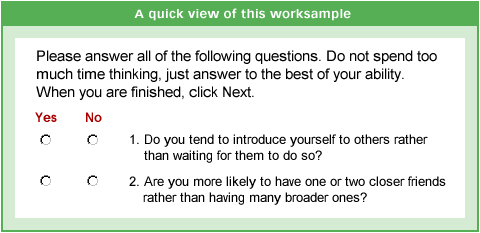
No one evidences Introversion or Extroversion all of the time; everyone shows some characteristics of both. Your score indicates that you have a preference for Introversion.
As an Introvert, you...
- Often get energy and renewal from time spent by yourself.
- Find yourself somewhat drained of energy after you've spent a good part of your time interacting with others - no matter how skilled you are at it.
- Are able to concentrate on solitary tasks for long periods of time without undue stress.
- Have a sense of choice about having or not having social interactions. (Extroverts usually feel they must have contact with others to be happy.)
- Like time to reflect before responding and to think before acting.
- Like quiet for concentration and reflection in developing ideas.
- Prefer to communicate by writing.
- Tend to be more private and contained and like structure in relationships and interactions; you prefer to have a reason to interact with others.
- Learn best by pausing to digest and think.
- Prefer lectures to interactive group discussion.

This worksample measures the span of time you tend to project and consider when making future plans or working on projects. It indicates how you consider naturally the impact of present actions on future plans.
As a person with a long Time Frame Orientation, you...
- Have a natural Time Frame of about five to ten years for making plans, thinking about your future, or considering the impact on your life of what you are doing now.
- Are able to sustain efforts that are largely unrewarded in the present to reap larger rewards later.
- Find this orientation helpful in jobs that require long-range planning, trend analysis, research, or extended negotiations.
- Can work to accomplish shorter Time Frame targets (two years, for example) by consciously breaking your long term goals into clear segments.
- May be so focused on the future that you do not pay enough attention to the immediate present, and to near goals.
- Can help yourself to control work in the shorter term by writing a list of your long-range goals and then a list on which you break each into shorter targets. This will force you to think through your natural time sense and to pay attention to tasks in the shorter term.
DRIVING ABILITIES
This section shows your results in five worksamples. Together, they are called the Driving Abilities. They are:
Classification;
Concept Organization;
Idea Productivity;
Spatial Relations Theory; and
Spatial Relations Visualization.
The Driving Abilities are very powerful and influence almost every part of our work lives. This is true whatever an individual's results. Each one of these abilities asserts itself in our lives. It is absolutely critical to take them into account when considering what role you should play at work.

This worksample indicates your ability to see relationships between seemingly unrelated events, situations, or information. It shows your ability to move from the specific to the general when solving the many problems you face every day.
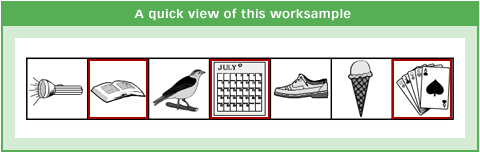
As a person with high Classification, you...
- Can easily and quickly see patterns and relationships among data and objects.
- Will find that this ability demands use and will influence almost every aspect of your working life.
- Need problem-solving as a foundation of your work
- Are likely to get positive enjoyment from using this ability, and to be unhappy in positions that do not use it.
- Love to solve new problems and to figure things out.
- Are able to quickly summarize a set of points and jump to the end of an argument.
- Can see pros and cons in any situation and the problems in a plan quickly and easily. On the negative side, unless you exercise self-discipline, you can be indecisive as a manager or decision-maker, because it is so easy for you to focus on alternatives.
- Can be easily bored in positions that require mostly routine, or rote, work.
- Do not like to be bothered learning the details of any subject and can usually gather enough information to get by or "wing it."
- Must use education and self-discipline to channel this ability properly - just because something is learned quickly does not necessarily mean it has been learned well.
- Can use this ability in any role where the major activity involves rapid-fire problem-solving, fixing, advice-giving or consulting.
- May find it difficult to communicate your solutions to others. (Classification is non-verbal and non-logical. See your results in Concept Organization.)
- Must find a steady means of applying this ability. You can become very dissatisfied if you are not using it regularly.

This worksample indicates your ability to arrange ideas, information, or things in a logical order. It shows your ability to move from the general to the specific to solve problems and to communicate the logic in doing so.
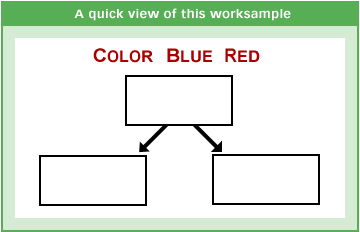
As a person with high Concept Organization, you...
- Are able to analyze ideas and concepts and to arrange them easily into their logical sequence. This enables you to make ideas clear to others. This is the primary ability for the communication of ideas to other people.
- Are able to see the logical consequences of events, making it possible for you to predict, order, and plan schedules showing when things will happen.
- Can see how all the pieces of a project fit together in a linear sequence.
- Can use this ability easily for any planning activity.
- Are able to organize internally and may not need to organize everything on your desk or around your house. (Others may see you as messy!)
- Enjoy arranging the parts of a task in sequence. You do not like to leave steps out of a sequence.
- Have an advantage in any kind of academic task that requires analytic thinking (i.e. literature, history, research, etc.).
- Will be able to use this ability effectively in any work in which there is a recurring need to analyze and organize materials or information; or to plan, prioritize or develop logical conclusions and consequences.
- Find that you will use this ability often, both in and outside of work. The opportunity to use it constantly in your life may substitute for the need to use it as part of your job.

This worksample measures the number of new ideas you can generate within a given time in response to a given stimulus. It does not reflect the quality or creativity of the ideas. It is a measure of the volume or flow of your ideas.
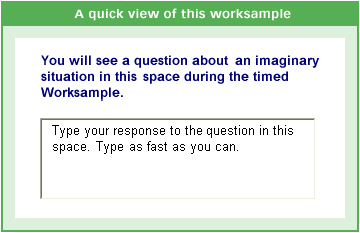
As a person with high Idea Productivity, you...
- Have a large number of ideas flowing through your head at any one time. You cannot turn this ability off at will.
- Enjoy using this ability and are able to come up with ideas at a rate which makes you highly useful in solving problems and overcoming the objections of others.
- Find this ability an advantage in any role demanding the rapid production of new ideas, and in problem solving and adjustment to new concepts.
- Are likely to be restless and dissatisfied in roles that demand only routine tasks and attention to small detail.
- May find it difficult to concentrate for long periods of time on a single subject or project, unless it is intrinsically interesting to you. You can compensate for this by doing work on a project for a short period of time and then coming back to it later.
- Find that it is relatively easy for you to dream up solutions for problems, to persuade others of your point of view, and to come up with alternative ways to explain or look at things when others do not understand.
- Should develop awareness that you may need to edit or think through many of your ideas before sharing them with others.
- Enjoy working in an environment in which your major roles are problem-solving and persuasion.
- Should use this ability in your work; otherwise you may feel frustrated. If Idea Productivity is not required in your job, you should encourage an outlet for it outside of work.

This worksample indicates your ability to see the theoretical relationships which exist in the working of the mechanical universe. It is the ability to understand how systems work: this applies to mechanical systems and interpersonal systems.
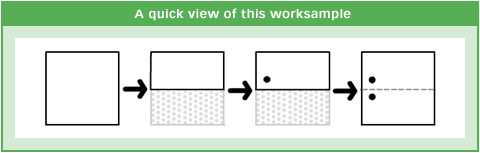
As a person with medium Spatial Relations Theory, you...
- Are able to draw upon this ability to solve abstract problems in a three-dimensional world
- Have some facility to understand theoretical and abstract situations. For example you can understand the theoretical relationships of mechanical systems - such as those used in engineering, astronomy, computer systems, and higher mathematics.
- Can see and mentally picture the interpersonal dynamics in systems such as corporations and families.
- Are able to design pieces of equipment and other tangible structures but are not necessarily interested in building them. (The ability to build tangible structures increases as this ability becomes stronger.)
- Need work enabling some direct contact with people and things and offering opportunities for developing theories and explanations about how they function and interact.

This worksample indicates your ability to see in three dimensions when shown only two. Spatial Relations Visualization is also related to needing "hands-on" experience and work.
Spatial Relations Visualization
Low
Med
High
Score
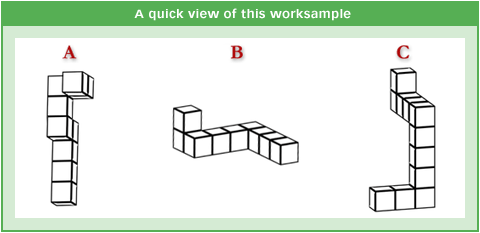
As a person with high Spatial Relations Visualization, you...
- Are a structural thinker and can easily think in three dimensions, as well as visualize and mentally manipulate objects in space.
- Have a drive to deal with the real world of three-dimensional objects and space and want to see the results of what you are doing in a concrete and tangible way.
- Are most at home in areas of work that utilize physical objects, products, machinery, and tools.
- Enjoy the touch and feel of tangible, concrete objects that are found in hands-on occupations.
- Can have a feeling that roles and tasks that deal mainly with ideas or relationships lack reality.
- Need to take this ability into account in your daily work.
SPECIALIZED ABILITIES
This section shows your results in nine worksamples. Together, they are called the Specialized Abilities. They are:
Design Memory;
Verbal Memory;
Tonal Memory;
Rhythm Memory;
Pitch Discrimination;
Number Memory; and
Visual Speed and Accuracy.
The Specialized Abilities help or enhance our work and lives. While most of them do not assert themselves as strongly as the Driving Abilities, it is important to pay attention to the patterns which form when these abilities combine with one another as well as with the Driving Abilities.

This worksample measures your ability to recall an overall pattern or picture presented in two dimensions; e.g., charts, diagrams, sketches and patterns of any kind.
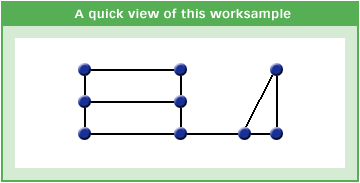
As a person with high Design Memory, you...
- Find it easy to remember two-dimensional visual patterns and are able to work comfortably with the overall patterns in visual material, as, for example in maps, architectural designs, and diagrams of any kind.
- Should find it easy to remember such things as the location of objects in a room and directions on a map.
- Can consider Design Memory to be a significant learning channel in and of itself and can easily translate information received in other forms into graphics such as diagrams and drawings.
- Need to find activities in which this ability can be used regularly, or you may feel vaguely dissatisfied.
- Will find this ability useful in many scientific, technical, and/or artistic tasks.

This worksample measures your ability to learn new words and recall what you have read quickly and easily.
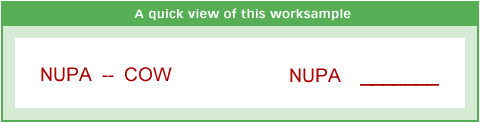
As a person with low Verbal Memory, you...
- May experience difficulty in memorizing information from the written word. Reading may be a relatively slow learning channel for you.
- Need to be sure to give yourself adequate time to work with written material.
- Can probably help yourself by "translating" the written word into other learning channels - e.g. by listening to books on tape, drawing diagrams, reading out loud, or associating words with pictures or diagrams.

This worksample measures your ability to remember what you hear, including tunes and tonal sequences.
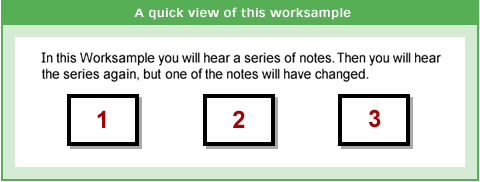
As a person with high Tonal Memory, you...
- Have a strong facility to remember tunes and tonal sequences, which you may use to sing and play music by ear.
- Have the auditory memory to reproduce the accent and tones of a foreign language.
- Should consider Tonal Memory a very important learning channel.
- Will feel a press to use this ability and may feel dissatisfied if you are not using Tonal Memory in some way. If any other scores on the other music abilities (Rhythm Memory and Pitch Discrimination) are in the medium range or above, this press to use Tonal Memory will be even stronger.
- Should experience very little problem in learning to play a musical instrument, especially one that "tunes" itself (e.g., keyboard or drums), particularly if you have some support from at least one of the other music abilities.

This worksample measures your ability to remember rhythm patterns. It also relates to kinesthetic learning, which is learning through movement.
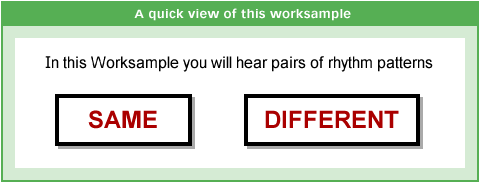
As a person with high Rhythm Memory, you...
- Can play music or musical instruments that lean heavily on rhythm or beat.
- May feel a demand for an outlet for this ability and can feel restless and unhappy if you ignore it.
- Have a general need for physical activity. Sitting at a desk all day will be hard for you unless you do something physical with your body. Walking, jogging, or playing sports are some ways to release this ability.
- Have a strong ability to remember movements of your body. Anytime you "act out" or "walk through" a learning activity, you are taking advantage of this ability.
- Should consider Rhythm Memory a strong learning channel.

This worksample measures your ability to distinguish fine differences in pitch. It also applies to perceptual discrimination across the senses.
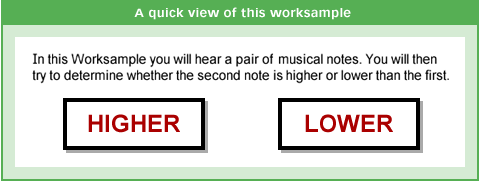
As a person with high Pitch Discrimination, you...
- Score well enough to sing or play a musical instrument well, even instruments like the violin or trumpet that lean heavily on the ability to distinguish pitch.
- (There is some evidence that you) have a strong ability to make the kinds of fine sensory discriminations required in such diverse tasks as gourmet cooking, photography, artistic painting, working with small instruments or machines, microscopy, or astronomy.
- Will find it easy to learn the inflection and accent of a foreign language.
- Will feel a press or need to use this ability and, depending on your other musical abilities (Tonal and Rhythm), should consider learning a musical instrument.
- Can pick up subtle changes in tone or inflection of voice, an ability useful in diplomacy and mediation.

This worksample measures your ability to recall miscellaneous facts and data. It indicates an ability to use numerical information to solve problems and make decisions.
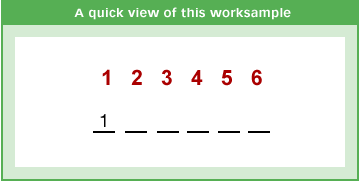
As a person with medium number memory, you...
- Are able to remember all sorts of facts from many different sources.
- Can remember those facts and numbers you need in your day-to-day tasks.
- Find this ability useful in roles that require instant access to facts and information.

This worksample measures your ability to read and interpret written symbols quickly and accurately.
Visual Speed
Visual Accuracy
Low
Med
High
Score
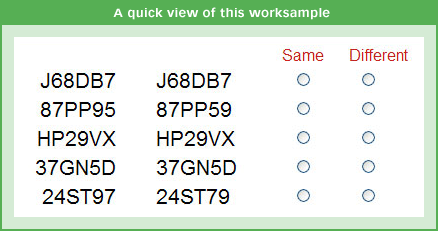
As a person with high Visual Speed and low Accuracy, you...
- Are able to move your eyes quickly; however, your low accuracy may cause difficulty where precision is important.
- May improve your accuracy, which is relatively more important in most tasks, by going at a slower rate. Over time, as you become more accustomed to the task, your speed will improve also.
- Can experience problems in tasks which require precision in paperwork and reading for accuracy, as in research, reading musical scores, etc.

Understanding each of your abilities is an important first step in understanding yourself. Understanding how groups of your abilities work together is a powerful tool. As a way of summarizing your results, we include a description of how your abilities relate to the four key dimensions of work life:
Work Environment/ Personal Style;
Learning;
Problem Solving/Decision Making; and
Communication.
WORK ENVIRONMENT/PERSONAL STYLE
As a key dimension of work life, Work Environment refers to the context or environment that is most conducive to your performing at your best. In determining whether a Work Environment is good for you, you must consider such factors as the pace of work, the amount of teamwork required and the amount of interaction with people involved.